February 12, 2026 | Nerve Pain
4 minute read
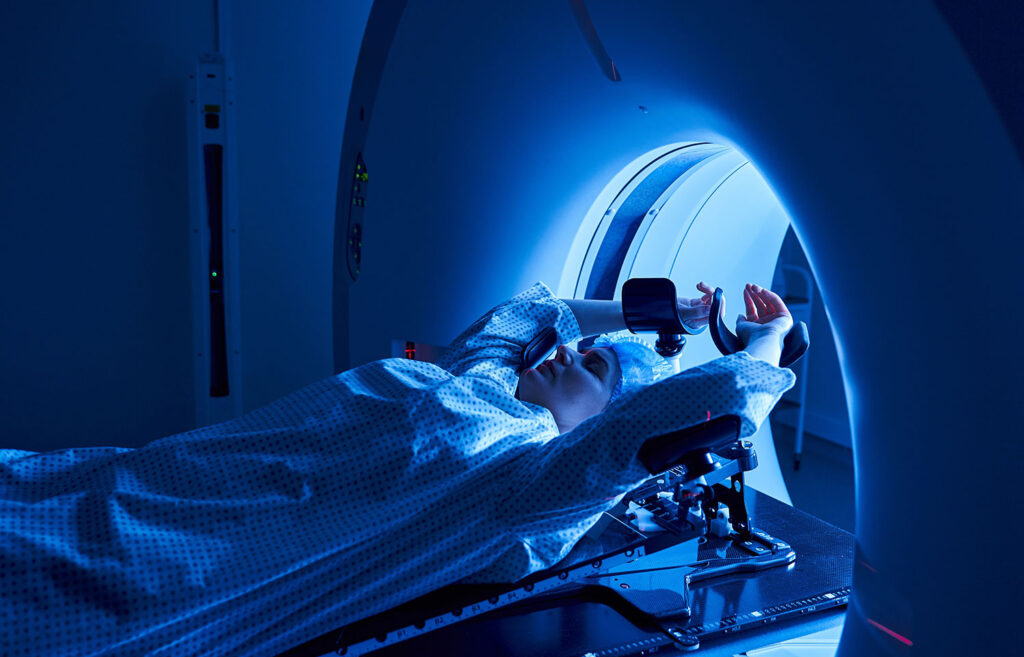
Like many things in medicine—and in life—a result can be viewed from more than one perspective. A “negative” or “normal” MRI does not mean that nothing is wrong. It simply means that certain serious conditions were not found. And that’s an important place to start.
On the positive side, your scan might show:
- No brain tumor
- No aneurysm
- No stroke
- No lesions concerning for multiple sclerosis, Alzheimer’s disease, or Lou Gehrig’s Disease
These are all significant and reassuring findings. A normal MRI rules out many dangerous and life-threatening causes of symptoms. But it still leaves a reasonable question: If my symptoms are real, why can’t we see the problem on imaging? The short answer: nerves are hard to see. Standard MRI scans are excellent for visualizing structures like bone, muscle, and large areas of the brain or spine. Small peripheral nerves, however, are a different story. They’re thin, delicate structures—often just a few millimeters wide—and on routine MRI sequences they can blend into the background. In many cases, they’re simply not highlighted well enough to evaluate reliably. So, the absence of visible pathology doesn’t necessarily mean the nerve is healthy. It may simply mean the scan wasn’t designed to look for that level of detail.
There are specialized MRI techniques specifically designed to evaluate nerves. These are collectively called magnetic resonance neurography (MRN). MRN uses tailored imaging sequences that preferentially highlight nervous tissue, allowing radiologists to better visualize:
- nerve inflammation
- compression
- swelling
- or structural abnormalities
When done properly, MRN can produce remarkably detailed images of larger nerve structures. The limitation is that this technology is still relatively specialized. Not every hospital offers it, and not every imaging center routinely performs or interprets it. Even with MRN, several practical factors affect what we can see:
- MRI strength (magnet power)
Standard scanners use 1.5 Tesla (1.5T) magnets. Newer 3T scanners provide higher resolution and more detailed images. Think of it like upgrading from an older video format to high-definition—the clarity improves. Higher strength scanners often make subtle nerve findings easier to detect.
- Nerve size
Larger nerves are easier to image.
MRN works well for structures like:
- spinal nerve roots
- the sciatic nerve
- the brachial plexus
Smaller peripheral nerves—such as those involved in carpal tunnel syndrome or occipital neuralgia—are much harder to visualize simply because of their size.
- Radiologist experience
Interpreting nerve imaging is a specialized skill. An experienced radiologist who regularly reads MRN studies is more likely to recognize subtle abnormalities than someone unfamiliar with these techniques. Image quality matters—but so does interpretation.
So why might your MRI be “negative”?
There are several common reasons:
- Standard sequences were used instead of nerve-specific imaging
- The scanner resolution wasn’t high enough
- The nerves of interest are very small
- The radiologist may not specialize in MR neurography
- Or simply: the problem is functional or microscopic and not visible on imaging
Importantly, many nerve-related pain conditions are clinical diagnoses—made based on your history, exam, and response to treatments—not imaging alone.
The takeaway
A normal MRI is reassuring, but it doesn’t invalidate your symptoms. It tells us what you don’t have. It doesn’t always show what you do have. If a nerve condition such as occipital neuralgia is suspected, it’s helpful for your physician to specifically request nerve-focused imaging and clearly communicate what they’re looking for. And one practical note: because MR neurography is still considered relatively new, some insurance companies may classify it as “experimental,” which can affect coverage. Bottom line: Imaging is a tool—not a verdict. Your symptoms and clinical evaluation remain just as important as the scan itself.